
Dmitry Vrubel and the kiss that changed the Berlin Wall
How a press photo from 1979 ended up painted on the Berlin Wall, and what the title underneath it did to the picture.
A family perspective by Artemiy Vrubel
3 min read
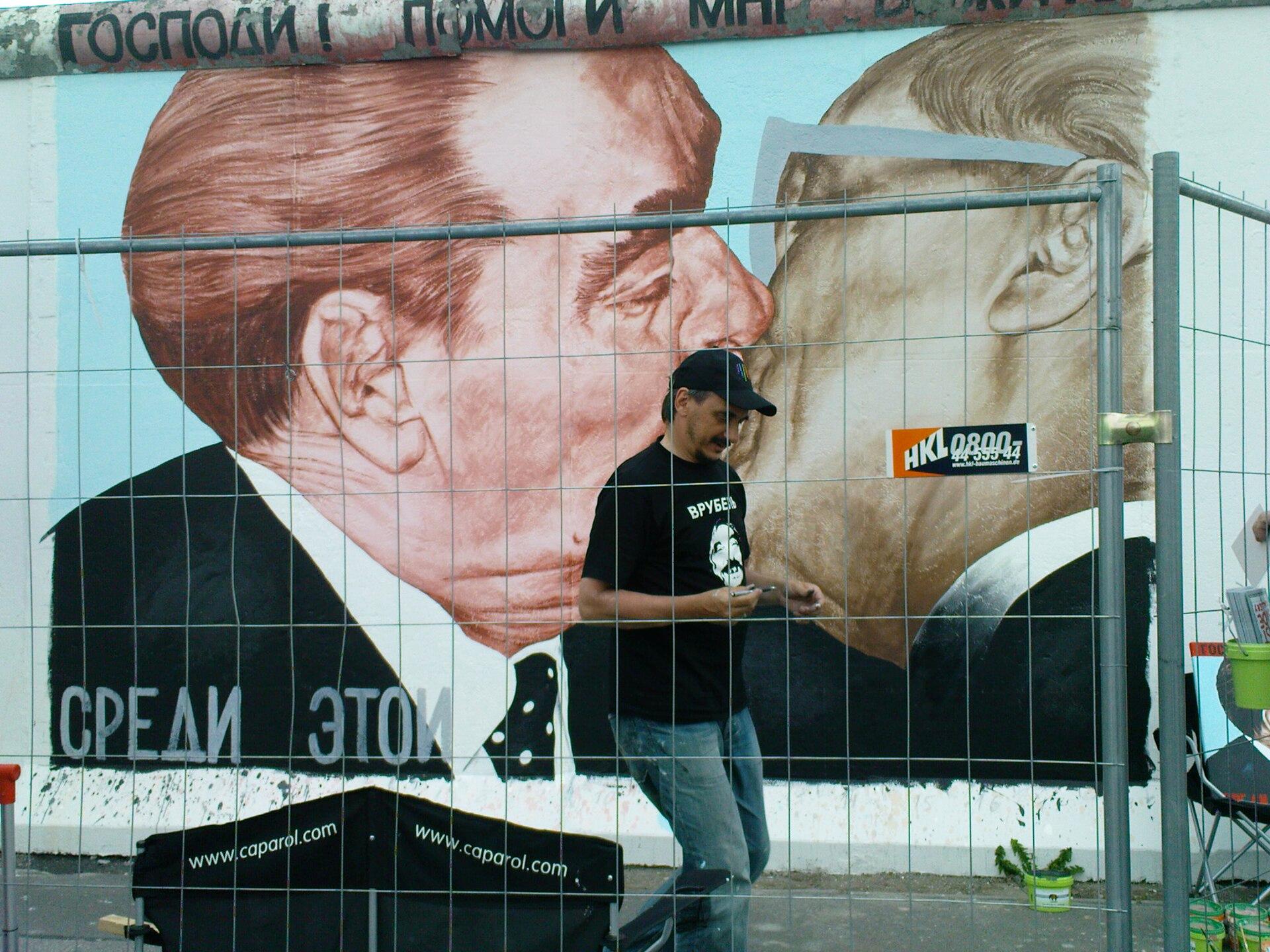
Dmitry Vrubel repainting “My God, Help Me to Survive This Deadly Love” at the East Side Gallery, 2009.
Everybody knows the picture. Two old men in suits, kissing on the mouth. What most people do not know is that it started as a news photograph, and that the sentence written underneath it on the wall is what made it stick.
A news photo becomes a wall
The photograph is by Régis Bossu, a French press photographer who was in East Berlin in October 1979 for the thirtieth anniversary of the GDR. Brezhnev and Honecker greeted each other the way socialist leaders did, Bossu got the frame, and the picture went round the world as “Le Baiser”. Eleven years later my father painted it on the Berlin Wall at a size you cannot walk past.
Then he wrote the title across it: “My God, Help Me to Survive This Deadly Love.” Without those words it is a news photo made large. With them it turns into a complaint, and it is not obvious who is doing the complaining. The Berlin Wall Foundation notes that the line came partly out of his own life at the time.
Berlin, 1990
He arrived in 1990, in a city that had just been put back together. Before that he had studied at the art and graphics faculty of the Lenin Institute in Moscow and run a gallery out of his own flat. What he did with existing images he called “multimedia graffiti”.
That spring, artists from 21 countries painted 106 works along 1.3 kilometres of the old border wall. It opened as the East Side Gallery in September 1990. They were painting on a wall that had been lethal to approach eighteen months earlier.
“The East Side Gallery is the victory of art over history.”
The other mural
The Bruderkuss is the one everybody photographs, but it was not his only wall there. The second is called “Thank You, Andrei Sakharov”, for the physicist who built Soviet weapons and then spent the rest of his life arguing against them.
Sakharov had died in Moscow only a few months before the wall was painted.
Painted twice
Weather and tagging wrecked the early paintings. In 2009 the gallery was restored and the original artists were asked back to redo their own work. My father repainted the kiss with Viktoria Timofeeva, his wife and studio partner, which is why both names stand at the foot of the wall. The photograph above is from that job.
He was paid 3,000 euro for it and gave the money to an art project in Marzahn.
1990 → 2026
What I do with it now
My father died in 2022. I make the BRUDERKUSS pieces in Berlin, by hand, one at a time, and each one gets its own number and its own certificate.
THE OBJECT
Made in Berlin by the Vrubel family.
A numbered piece, with a chip inside that opens its own certificate.